Cracking Marketing Intelligence at Scale: How We Drove +30% ROI Across 140 Brands
18 months ago, we set out to do the impossible at Kitopi: optimize marketing spend across 140+ brands on aggregator platforms like Deliveroo, Talabat, Careem, and Noon.
Different geographies. Different rules. Limited APIs. Highly contextualized audiences. Leadership doubted it would deliver real impact. They were almost right.
The results:
- +30% ROI uplift (efficiency improved from 3.47 → 5.0)
- 22% YoY ROI growth with 29% less spend
- 480+ branches fully automated
- Forecasting accuracy within ~1% error rates
The numbers are impressive — but the lessons behind them are even stronger.
Starting From Zero
When we began, the situation looked like this:
- No reliable data streams
- No standardized processes
- Marketing operations fully manual
- Campaign setup took 5 days
- Budgeting driven by gut feeling, not data
We had no playbook to follow. So we built one.
What Made It Possible: One Team
The breakthrough wasn’t just technology — it was people.
Instead of working in silos, Product, Business, Engineering, and Data became one team. Other teams noticed how naturally we collaborated.
- No APIs? Engineering hacked creative workarounds
- Messy data? Data scientists worked directly with business to standardize
- Impossible models? Lalit (our ML genius) and Younes built systems that worked in the real world
- Overwhelming execution? Maciej and the Espresso team made it seamless
The lesson: Cross-functional isn’t enough. Integration is the real multiplier.
Step by Step: Solving One Problem at a Time
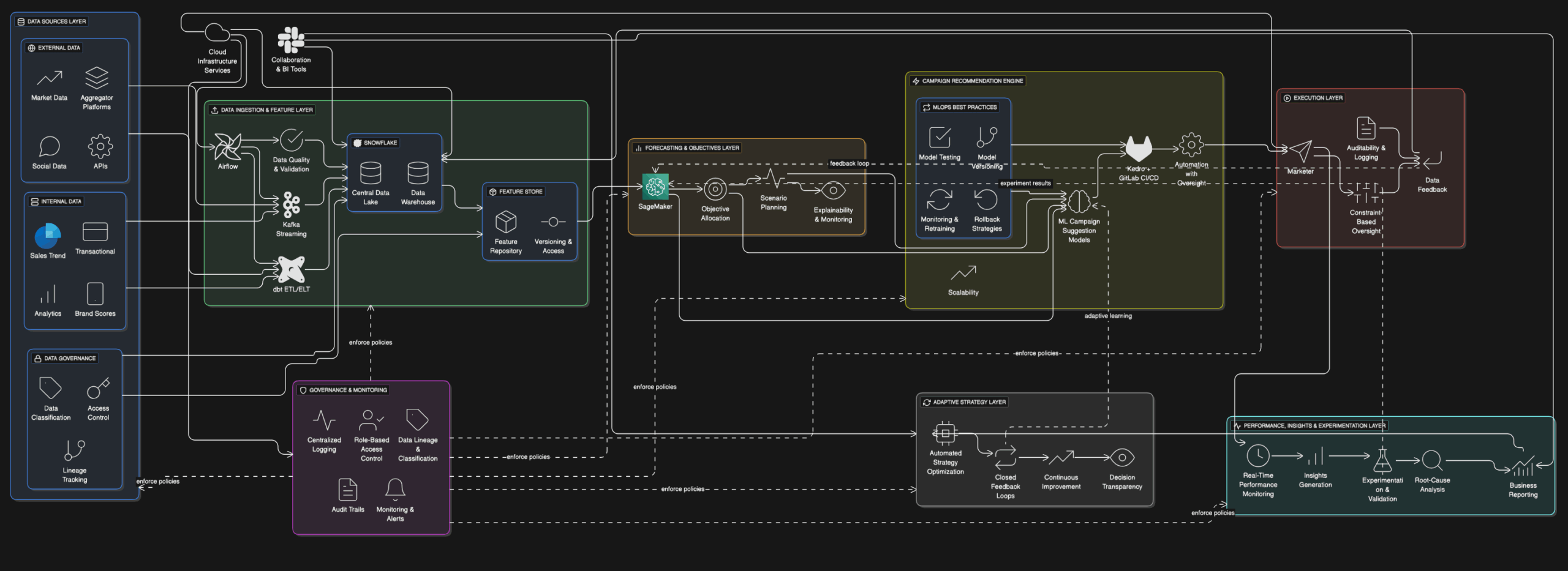
We didn’t try to build everything at once. Each milestone built on the last:
- Reliable data → scraping, standardization, one source of truth
- Automation → cut campaign setup from 5 days to 0.5 days (90% faster)
- ML models → predicted & optimized performance across brands
- Adaptive strategy logic → real-time, portfolio-aware adjustments to keep local tactics aligned with global goals
Our biggest differentiator — adaptive strategy — only worked because we nailed the foundations first.
The lesson: Have a roadmap, but execute one milestone at a time.
From Gut-Feel to Data-Driven
We created a “single source of truth” for all performance data before scaling anything. This meant scraping when APIs didn’t exist, standardizing formats, and locking down baselines.
Once stable, we iterated fast:
- Forecasting accuracy within ~1% error rates
- Hundreds of small improvements → compounding impact
- MVP outperformed controls by +16% while spending 25% less
The lesson: You can’t optimize what you can’t measure.
The Breakthrough: Adaptive Strategy
Here’s where we cracked it.
Our adaptive strategy logic continuously compared planned vs. actual performance, then adjusted campaigns in real time:
- Shifted budget allocation
- Adjusted discounts
- Changed ad intensity
- Recommended alternative promotions
All while ensuring portfolio-level targets stayed on track.
This meant hyper-local strategies at branch level + company-wide optimization at scale. Surgical precision instead of broad-brush marketing.
The result: Contribution margin jumped across the board.
What Makes This Unique
This wasn’t just another automation project. It was a market-first achievement:
- First system to deliver portfolio + hyper-local optimization at this scale
- Delivered +30% ROI improvement under tighter budgets
- Achieved even where APIs didn’t exist
- Powered by an integrated cross-functional team, not just tech
The Bigger Picture
Today, we’re processing marketing decisions for 140+ brands across multiple countries — each requiring different strategies based on local market dynamics, brand equity, and customer behavior.
The system combines:
- Human expertise (brand, market, customer insight)
- Machine learning (adaptive, real-time optimization)
- Integrated teams (solving problems as one unit)
The result: gut-feel marketing turned into precision-guided investment.
Looking forward, forecasts show potential to 10x marketing uplift by 2028, with proportional gains in contribution margin. But the real opportunity extends beyond Kitopi: this methodology can transform how any multi-brand, multi-market company approaches marketing.
Final Thought
The future of marketing isn’t about bigger budgets or broader campaigns. It’s about intelligent systems that learn and adapt in real time — powered by integrated teams who turn ambitious visions into measurable reality.
What challenges are you facing with marketing optimization at scale?
I’d love to hear how you and other leaders are tackling similar challenges — drop me an email and let’s compare notes.